When an assault or other injury happens on someone else’s property, a central question may be whether reasonable security could have helped prevent it. A negligent security lawyer in South Carolina can assess how the property’s conditions, known risks, and available evidence relate to an injury claim. The answer depends on the specific facts; an incident alone does not establish that an owner is legally responsible.
What does negligent security mean?
Negligent security is a type of premises-liability claim. It concerns an injury allegedly caused, at least in part, by inadequate steps to address a foreseeable safety risk on property. Depending on the circumstances, the property owner, occupier, manager, or another party may have responsibility for the area and its safety measures. Identifying who controlled the relevant space is an important early question.
Security measures can vary with the property and its use. They might include lighting, locks, controlled entry, cameras, staff presence, patrols, or procedures for responding to reports. A claim does not necessarily require a particular device or a security guard. The issue is whether reasonable measures were appropriate in light of the circumstances and whether an alleged failure contributed to the injury.
The U.S. Department of Justice’s overview of premises liability and negligent security discusses the relationship between property liability and security issues. Read the Department of Justice resource. It is general background, not a decision about any particular South Carolina incident.
What facts may show that a risk was foreseeable?
Foreseeability asks whether the type of harm was sufficiently predictable under the circumstances that reasonable precautions may have been called for. It does not mean an owner must anticipate every possible crime or guarantee that no incident can occur. The inquiry is fact-specific. Prior incidents can matter, but they are not the only information that may be relevant.
Evidence of notice may include prior calls for assistance, police reports, complaints to management, maintenance requests, or reports of trespassing and disturbances. The timing, location, and nature of those events may matter. A past incident in a different building or involving a different kind of danger may carry less weight than repeated, similar events in the same area. A lack of reported incidents does not automatically resolve the issue either; other conditions or information may be relevant.
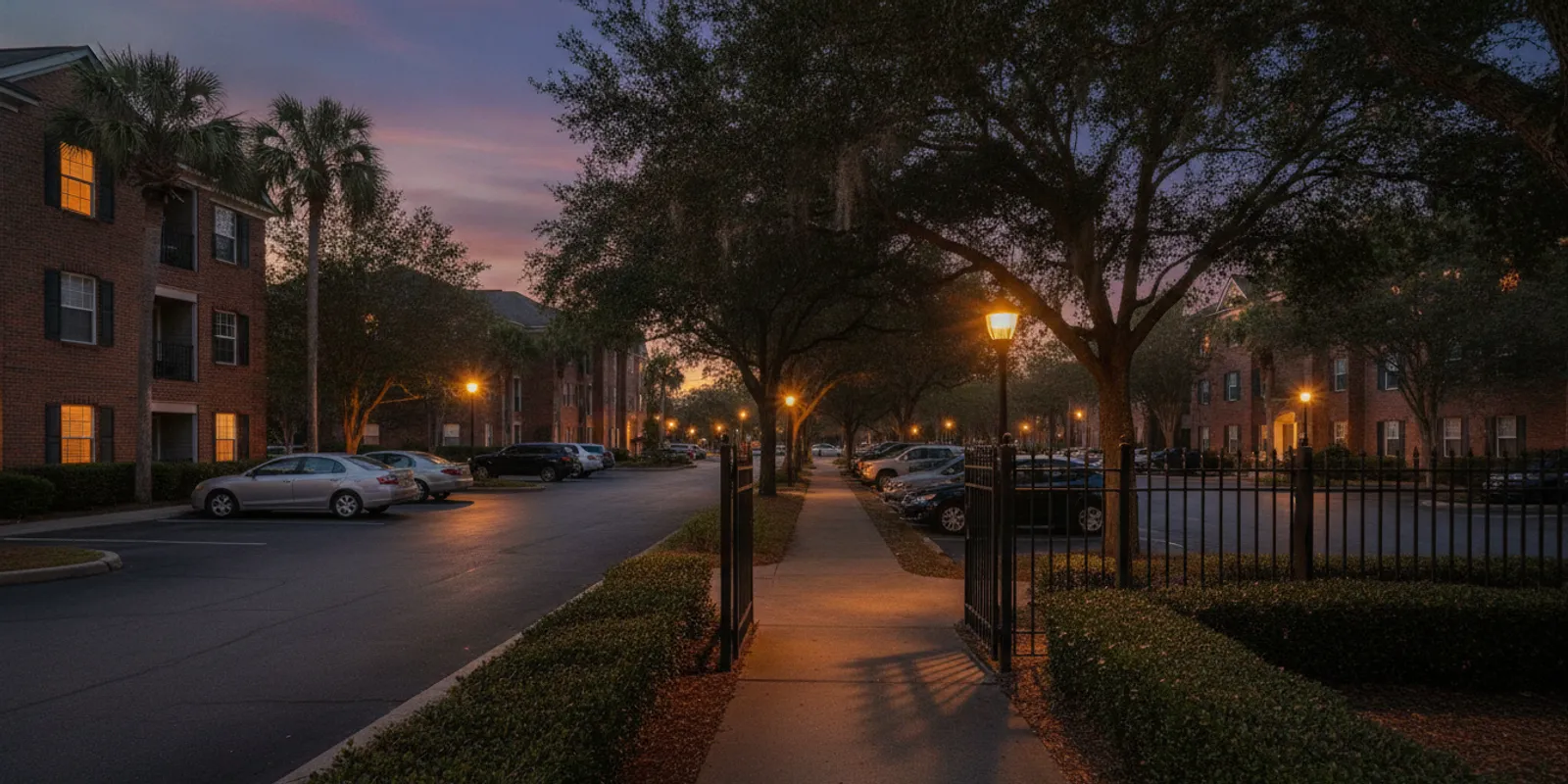
Consider an apartment parking lot where a resident reports that an access gate remains broken and unfamiliar people regularly enter. If the gate stays unrepaired and a later attack occurs in the lot, repair records, complaints, and information about who received them may help establish what management knew and when. Those facts would not by themselves prove liability. They would be part of the broader assessment, including causation and the response that was reasonable at the time.
For another example, a business may receive reports of assaults near a poorly lit entrance. Relevant questions could include whether the reports were communicated to the people responsible for the property, whether the lighting was inspected, and whether practical steps were taken. Each case must be evaluated on its own evidence.
Who may have responsibility for security?
Responsibility may depend on ownership, possession, maintenance, and control. The owner may have delegated day-to-day management to a property company. A tenant may control an interior space, while a landlord maintains shared corridors or parking areas. A security contractor may have a limited role under an agreement. Sorting out those relationships can help identify which records and witnesses to seek.
Documents that may clarify control include leases, management agreements, maintenance contracts, security policies, and work orders. These records may not be available to an injured person immediately, but a lawyer can assess how they relate to the claim and whether formal steps are needed to obtain them. Avoid assuming that the person named on a sign or bill is the only potentially responsible party.
Where the injury occurred also matters. A stairwell, sidewalk, parking area, lobby, or business entrance may be managed differently from a unit or leased space. Note the precise location and how you entered it. Photographs, maps, and a clear description can prevent confusion later about which party maintained the area.
How can lighting and access conditions matter?
Physical conditions can affect both the opportunity for harm and the ability to see or respond to danger. A broken light, obstructed sightline, damaged lock, propped-open door, or malfunctioning access system may become relevant when connected to the risk and the incident. The presence of a defect alone does not establish that it caused an injury; the timing and context matter.
Try to document conditions from more than one angle, if it is safe to do so. Record the location of lights, doors, gates, cameras, signs, and nearby entrances. Note whether a light was out, a door would not latch, or a gate was open. If conditions are repaired quickly, a prompt record may help preserve what the area looked like beforehand. Do not trespass or put yourself at risk to gather evidence.
Access records may help answer whether a gate or entry system was working, who had access, or whether management received an alert. Camera footage can be overwritten or retained for a limited period, so prompt notice that relevant footage should be preserved may be important. Do not try to access a system without permission. Keep any written response about footage, repairs, or incident records.
What evidence should you preserve after an incident?
Start with your safety and medical care. Seek appropriate treatment and follow the instructions of your medical providers. If you can, keep copies of discharge papers, treatment records, prescriptions, and work restrictions. These records document the injuries and care; they do not, by themselves, establish who was legally responsible.
Make a private, dated account while events are fresh. Include the time, location, lighting and access conditions, what happened before and after the injury, and the names of people you spoke with. Separate what you personally observed from what someone else told you. If you do not know an answer, mark it as unknown rather than guessing.
- Photograph the relevant area, including entrances, lighting, locks, gates, signs, and sightlines, if it is safe and lawful.
- Save messages, emails, or letters to and from the owner, manager, or security staff.
- Ask witnesses for their contact information and note what each person observed.
- Keep the incident number and the name of the agency or responding personnel, if applicable.
- Write down the names of people who were told about the conditions and approximately when those conversations occurred.
- Keep damaged clothing or personal items in their current condition, if relevant, and photograph them before cleaning or repair.
Do not alter, edit, or publicly post evidence in a way that could obscure its original context. Preserve original photographs and messages where possible. If you send a written request to retain video or records, keep a copy and proof of delivery. A lawyer can advise what requests are appropriate and how to pursue records that are not voluntarily provided.
Which records and witnesses can help explain notice?
Incident reports, complaints, maintenance logs, inspection records, work orders, camera footage, and security schedules may shed light on the property’s conditions and the owner’s response. The records that matter will depend on the setting. For an apartment complex, a tenant portal complaint or gate repair ticket may be useful. For a store, reports to management and records of lighting inspections may be relevant.
Witnesses can include people who saw the incident, people who reported earlier problems, employees who responded, or contractors who repaired a condition. A witness’s first-hand knowledge is different from an account repeated by someone else. Record each person’s name and contact details if available, but do not pressure anyone to adopt a particular version of events.
Make a simple timeline, using approximate times where exact ones are unknown:
- When did the dangerous condition first appear, or when did you first notice it?
- Who reported it, and to whom?
- What did the property representative do in response?
- When did the injury occur, and what conditions were present then?
- What steps followed, including medical care, reports, and repairs?
This timeline can help reveal gaps that need follow-up. It can also distinguish what is supported by a record from what still needs confirmation. Do not fill gaps with assumptions.
How do these facts connect to an injury claim?
A negligent security case generally involves more than proof that an injury occurred on property. The evidence must be assessed in relation to the relevant legal duties, whether a risk was foreseeable, what the responsible party knew or should have known, what precautions were reasonable, and whether an alleged failure caused or contributed to the harm. The specific legal analysis depends on South Carolina law and the facts.
Medical documentation helps describe the injury, treatment, and effects on daily activities. Photographs and witness accounts may establish the conditions and sequence of events. Reports and maintenance records may help show notice or response. Contracts and property records may help identify control. No single item necessarily answers every question.
There may also be disputed issues about how the incident happened, who controlled the area, or whether a proposed security measure would have made a difference. An insurance company may request a recorded statement or documents. Before providing a detailed statement or signing a release, consider getting legal advice about the request and its possible effect on a claim.
Hammack Law Firm handles premises-liability matters, including injuries involving property conditions. You can read about the firm’s Greenville premises liability practice and its slip-and-fall injury work. These pages provide general information; the label on a claim does not determine whether the facts support it.
What should you ask a lawyer about the claim?
An initial conversation can be more useful if you have a concise account and a few focused questions. You do not need to solve the case or collect every document before seeking guidance. Share what you know, identify what is missing, and be candid about facts that may be unfavorable as well as helpful.
- Who controlled the specific area where the incident happened?
- What records might show earlier reports, repairs, or security procedures?
- Should a preservation request be sent for video or electronic access records?
- What additional information is needed to evaluate foreseeability and causation?
- What deadlines may apply to the facts and parties involved?
- How will communication and case expenses be handled?
Bring photographs, a timeline, medical information, and any incident paperwork that you already have. If you have not obtained a record, simply note that. If you are already represented by a lawyer, speak with that lawyer about the incident rather than seeking overlapping representation.
How can you compare the evidence at an early stage?
The following table is a practical way to organize questions, not a legal test or a prediction about the result.
| Evidence area | What it may help clarify | Practical next step |
|---|---|---|
| Prior reports | What concerns were raised, when, and to whom | Save messages, report numbers, and names of recipients |
| Lighting and visibility | What a person could see in the relevant area | Photograph lights and sightlines promptly, if safe |
| Locks, gates, and access | Whether entry controls were functioning or monitored | Note the condition and request preservation of relevant records |
| Video and electronic logs | Movement, timing, alerts, or the sequence of events | Record camera locations and send a timely preservation request |
| Maintenance records | Whether a defect was reported, inspected, or repaired | Keep repair communications and identify possible work orders |
| Medical and incident records | Injuries, treatment, and how the event was reported | Retain copies and note the dates they were created |
What makes security evidence difficult to evaluate?
Records may be incomplete, inconsistent, or controlled by someone else. A witness may remember the general event but not the exact time. A property may have changed its lighting or access system after the incident. These difficulties do not automatically defeat a claim, but they make careful documentation and follow-up important.
There can also be a difference between a property’s written policy and what actually happened. A policy may describe patrols or inspections, while schedules and logs show whether those steps occurred. Conversely, a missing record does not necessarily prove that no action took place. Evidence should be read in context and compared with other information.
For that reason, preserve original materials and avoid drawing conclusions from one photograph, one report, or one conversation. Note uncertainty clearly. A lawyer can assess whether additional records, testimony, or investigation may be appropriate.
Frequently asked questions
Does an injury on private property automatically mean the owner is liable?
No. The location alone does not establish responsibility. The facts may need to show a relevant duty, a foreseeable risk, an unreasonable failure to address it, and a connection between that failure and the injury. The assessment depends on the circumstances and applicable law.
Are prior crimes required for a negligent security claim?
Prior incidents may be relevant to whether a risk was foreseeable, especially when they are similar and occurred nearby. They are not the only facts that may matter. Reports, conditions, property use, and other information known to the responsible party may also be considered.
What if the property fixes the problem after the injury?
A repair may change the conditions you can observe later, which is one reason to document the area promptly and preserve communications. The fact of a later repair does not by itself resolve whether the party was responsible before the incident. Preserve what you have and ask a lawyer how the timing may matter.
Should I request surveillance video myself?
You may make a written request that relevant footage be preserved, but there is no guarantee it will be provided voluntarily. Video systems may overwrite footage, so timing can matter. Keep a copy of any request and response, and do not attempt to access a private system without authorization.
When should I speak with a lawyer?
Consider seeking legal guidance promptly, particularly if there may be video, electronic access records, or witnesses whose memories could fade. Deadlines can depend on the parties and facts, so do not assume you have unlimited time. A lawyer can discuss the circumstances and possible next steps without promising a particular outcome.
Contact Hammack Law Firm to discuss the incident
Negligent security claims require a careful look at the property, the risks known before the incident, the response, and the evidence connecting those facts to an injury. Preserve what you can safely document and get advice tailored to the circumstances.

With over 25 years of legal experience, Paul Hammack provides his clients with a level of trial expertise and strategic insight rarely found in personal injury litigation. Having spent the first eight years of his career working within major insurance defense firms across Georgia and South Carolina, Paul gained an intimate understanding of the “other side’s” playbook. This insurance industry background serves as a unique differentiator for his clients; he knows exactly how insurance carriers evaluate risk and what motivates them to pay top dollar for a claim.
In 2008, Paul founded Hammack Law Firm to move away from the “plaintiff mill” model and focus on building personal relationships with those he represents. As a seasoned litigator, he has tried dozens of first-chair cases to verdict, specializing in high-stakes litigation involving catastrophic injuries and complex truck accidents. His dual-state practice allows him to provide aggressive representation across both South Carolina and Georgia, ensuring victims of negligence receive the maximum financial compensation possible regardless of which side of the state line the accident occurred.
Paul’s commitment to excellence is reflected in his record of significant achievements, including a $10 million tractor-trailer wrongful death settlement and a $3.9 million moped-versus-truck recovery. His credentials and bar admissions in both South Carolina and Georgia underscore his deep roots in the regional legal community. Beyond the courtroom, Paul is a dedicated advocate for his local community, contributing his time and resources to organizations such as the United Way, Red Cross, and Hands On Greenville, all while working to make South Carolina a safer place for everyone.