


A bicycle collision in Greenville can leave you dealing with pain, a damaged bike, missed work, and an insurance process that feels hard to navigate. Whether the crash happened on a city street, near a trail crossing, or at an intersection, the first decisions can affect the evidence available for a potential claim.
Contact Hammack Law Firm about your Greenville bicycle collision.
This guide explains practical next steps for a South Carolina cyclist or family member. It is general information, not a promise of a result or a substitute for advice about your specific facts.
What should you do after a bicycle collision in Greenville?
Short answer: Move to a safe location if possible, call 911 for emergencies, obtain medical care, document the scene, gather witness information, and preserve the bicycle and damaged equipment. Avoid guessing about fault or giving a recorded insurance statement before you understand what happened.
Safety comes first. If you are in traffic, ask for help moving away from immediate danger without disturbing important evidence more than necessary. Request law enforcement assistance when someone is injured, the roadway is hazardous, or the circumstances are disputed. Ask how to obtain the incident report and write down the report number.
- Get medical attention: A medical evaluation creates a record of symptoms and can identify injuries that are not obvious immediately after a crash.
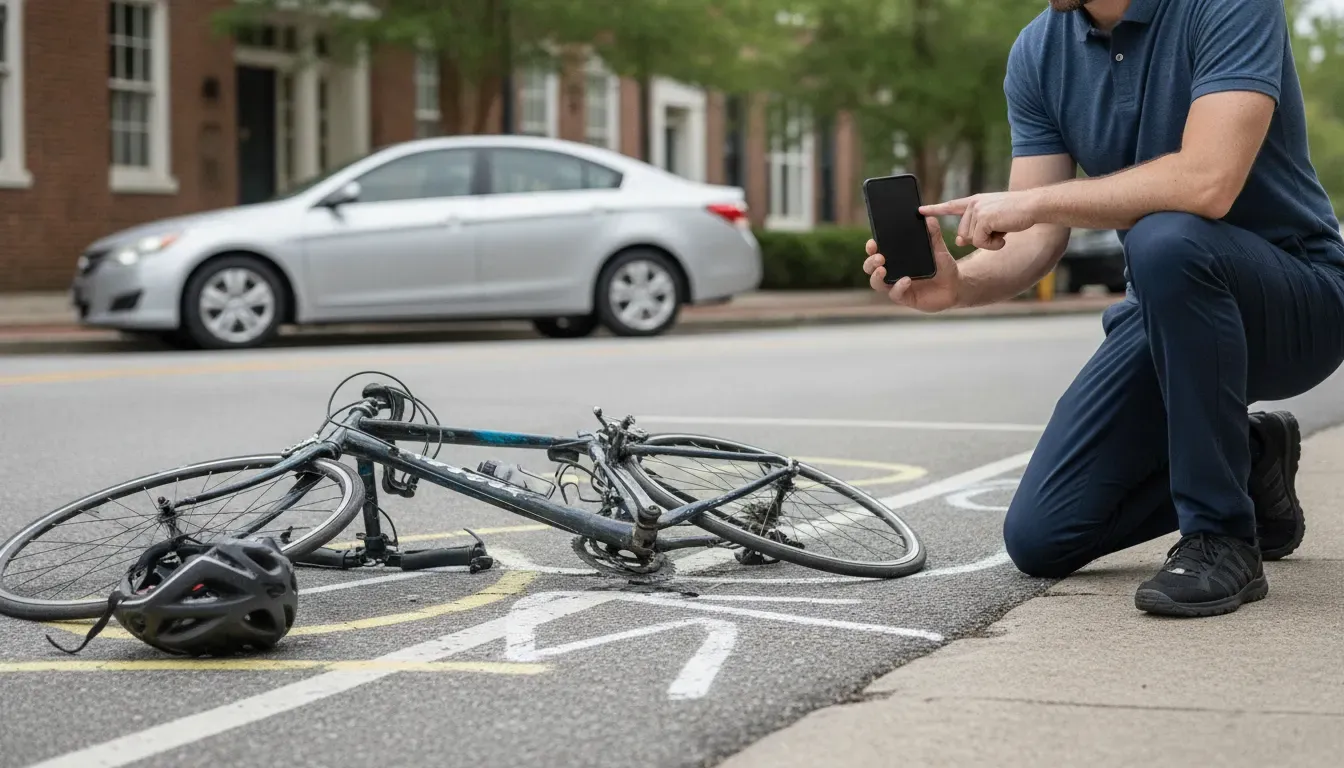
- Preserve the scene: If it is safe, photograph the bicycle, vehicle, roadway, signs, signals, debris, lighting, and visible injuries. Take wide images and close-up images.
- Collect information: Record the driver’s name, contact information, license plate, insurance details, and the names and contact information of witnesses.
- Save physical evidence: Do not repair, discard, or clean the bicycle, helmet, clothing, lights, or other equipment before they can be documented.
- Keep a recovery log: Save medical records, bills, prescriptions, mileage, work records, and notes about symptoms and restrictions.
Do not put yourself back in danger to take a photograph. A witness, nearby business, or public agency may have video that can help fill gaps later, but video systems often overwrite recordings. Record the names of nearby businesses and the approximate time of the collision so a request can be directed to the right place.
How does the Greenville location affect the claim?
Short answer: A Greenville collision may involve roadway design, traffic controls, trail crossings, lighting, visibility, and nearby video. The location does not decide fault by itself, but accurate local details can help investigators reconstruct the sequence and identify available evidence.
Greenville riders use a mix of city streets, designated bicycle facilities, neighborhood roads, and multi-use trails. The City of Greenville identifies the Swamp Rabbit Trail as a local trail resource, but a trail or crossing does not eliminate the need to examine the particular traffic pattern and right-of-way at the scene. A collision near a trail connection may require different evidence from a crash in a travel lane.
Note the exact location rather than relying only on a general label such as downtown Greenville. Record the nearest cross streets, direction of travel, lane or shoulder position, signal phase if known, nearby businesses, and whether construction, parked vehicles, foliage, weather, or darkness affected visibility. A map pin and contemporaneous photographs can be useful.
For local trail information, see the City of Greenville’s Swamp Rabbit Trail page. That page is a community resource, not a determination of responsibility for an individual crash.
What South Carolina bicycle rules may matter?
Short answer: South Carolina generally gives a person riding a bicycle on a roadway the rights and duties applicable to a vehicle driver, subject to bicycle-specific rules. Drivers must maintain a safe operating distance from bicycles. The facts of the collision determine whether a rule is relevant to a civil claim.
The South Carolina Code Section 56-5-3420 addresses the rights and duties of bicyclists on a roadway. Related provisions address bicycle lanes and roadway positioning, including when a cyclist may need to avoid an obstruction or continue in a different lane. The South Carolina Department of Public Safety summarizes bicycle guidance and directs readers to Title 56, Chapter 5, Article 27 for more information.
For drivers, South Carolina Code Section 56-5-3435 states that a motor-vehicle driver must maintain a safe operating distance between the vehicle and a bicycle. The rule may be relevant evidence, but citing a traffic rule does not automatically prove civil liability. The investigation still must consider what each person did, what caused the collision, and what injuries and losses followed.
Read the South Carolina Department of Public Safety bicycle guidance for a plain-language overview. The agency explains that its summaries are not a substitute for the full Code of Laws. That distinction matters because a claim may involve exceptions, competing evidence, and facts not captured in a short description.
What evidence can support a bicycle collision claim?
Short answer: Useful evidence may include photographs, video, the incident report, witness accounts, vehicle and bicycle damage, medical records, employment records, and communications with insurers. Evidence is strongest when it is preserved promptly and tied to the time, place, and sequence of the collision.
| Evidence | What it may help show |
|---|---|
| Scene photographs and video | Road position, signals, sightlines, debris, lighting, and conditions |
| Bicycle, helmet, clothing, and vehicle damage | Contact points, impact direction, and the force or mechanics of the event |
| Witness information | Independent observations about movement, signals, speed, and visibility |
| Medical records and bills | Diagnosis, treatment, restrictions, expenses, and the timing of symptoms |
| Work and income records | Missed time, modified duties, and claimed income loss |
Preserve original files when possible. Do not crop away context from the only copy of a photograph, and do not edit video in a way that removes metadata or surrounding footage. Keep a separate copy of posts or messages that may show your condition or the event, and avoid speculating about fault in public posts.
Some collisions involve a driver’s failure to see a cyclist, a turning movement, a door opening, a failure to yield, or an unsafe pass. If a parked-car door caused the crash, Hammack Law Firm’s article on South Carolina bicycle dooring liability addresses that narrower situation. This article is focused on the broader Greenville claim process rather than one collision type.
How can insurance and fault questions affect a claim?
Short answer: An insurer’s initial position is not necessarily the final answer. South Carolina fault rules are fact-dependent, and evidence about traffic signals, visibility, roadway position, and medical causation may affect how responsibility and damages are evaluated.
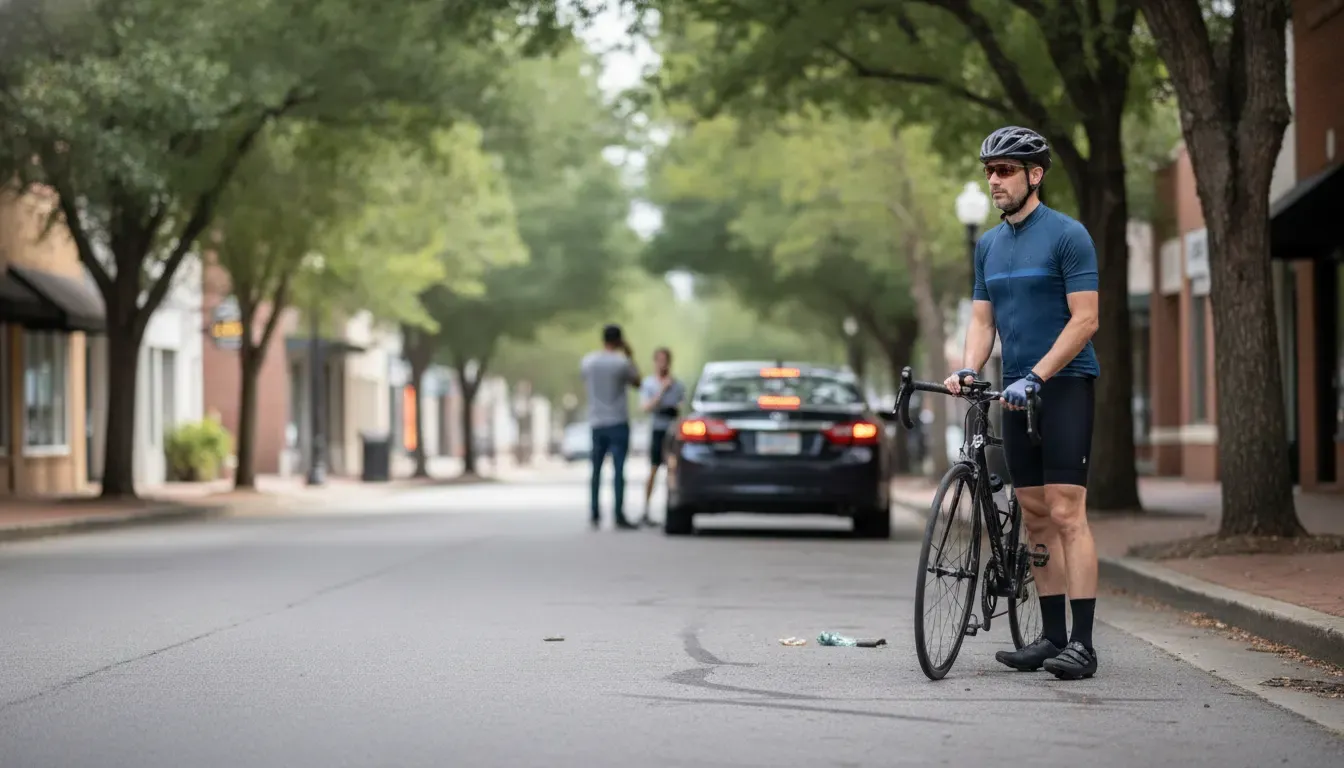
Give an insurer accurate basic information about the collision and cooperate with reasonable requests, but do not guess when you do not know an answer. A request for a recorded statement, broad medical authorization, or quick settlement may deserve careful review before you agree. Keep copies of letters, claim numbers, estimates, and messages.
South Carolina’s civil-liability rules can require consideration of the conduct of more than one person. South Carolina Code Section 15-38-15 addresses apportionment and the treatment of fault in actions involving personal injury and other damages. The statute is not a calculator for every bicycle case. The available evidence, the parties involved, the insurance policies, and the legal theories can all matter.
If a driver denies involvement, the insurer disputes the sequence, or more than one party may be involved, gather the evidence before it disappears. A lawyer can help organize the timeline, identify unanswered questions, and communicate with insurers. That does not mean every collision requires a lawsuit or that any recovery is guaranteed.
Request a case review from Hammack Law Firm after a Greenville bicycle collision.
What losses may be part of a bicycle collision claim?
Short answer: Depending on the evidence and applicable law, a claim may involve medical expenses, future treatment, lost income, bicycle and equipment damage, pain, and other losses connected to the injury. The amount and availability of any recovery depend on the facts, proof, fault, and insurance.
Keep a folder for every expense and record why it relates to the collision. That may include emergency care, follow-up appointments, therapy, medication, transportation to treatment, replacement or repair estimates, and time missed from work. Ask healthcare providers questions about restrictions and follow their instructions.
Some injuries are immediately visible. Others become clearer over time, particularly when pain, dizziness, sleep problems, or movement limitations develop after the initial shock. Do not minimize symptoms for an insurer or abandon medical follow-up because the bicycle damage appears more obvious than the physical injury.
Property damage is also evidence. Photograph the bicycle and equipment before repairs, keep purchase or maintenance records if available, and obtain estimates rather than discarding damaged components. If the bicycle is unsafe, store it securely and ask before authorizing work that could remove useful evidence.
When should you contact a Greenville bicycle accident lawyer?
Short answer: Consider prompt legal guidance when injuries are serious, fault is disputed, an insurer requests a recorded statement, a claim is denied or undervalued, evidence may disappear, or the collision involves a government entity, commercial vehicle, or multiple parties.
A brief conversation can help you understand what information to preserve and which deadlines may apply. Hammack Law Firm handles personal injury matters in South Carolina and provides a direct contact path for people who want to discuss a collision. The firm does not promise an outcome, and a case decision depends on the facts and applicable law.
You can also review Hammack Law Firm’s Greenville bicycle accident service page for the firm’s local practice information. That service page and this article have different jobs: the service page explains representation, while this article provides a post-collision roadmap.
South Carolina generally provides three years for an action involving an injury to a person under Section 15-3-530. This is a general statute-of-limitations reference, not a deadline calculation for your case. Different facts can change the analysis, and waiting can make it harder to preserve evidence. Contacting a lawyer early does not require you to file a lawsuit.
Frequently asked questions
What should I do if I was not seriously hurt at the scene?
Still document the collision and monitor your health. Some symptoms appear later, and a medical professional can advise whether evaluation is appropriate. Preserve the bicycle, equipment, photographs, witness information, and insurance communications even if the initial pain seems manageable.
Can I have a claim if I swerved to avoid a vehicle?
Possibly. A collision does not always require direct contact between a bicycle and a vehicle. The evidence must connect an unsafe action or other legally relevant conduct to the evasive maneuver, fall, and injury.
Should I post photographs or details about the collision online?
Public posts can be misunderstood or taken out of context. Preserve your original evidence privately and avoid arguing about fault or describing your injuries in speculative terms while the facts are being evaluated.
What if the driver has no insurance or not enough insurance?
Potential insurance sources depend on the policies, household circumstances, and facts. Do not assume there is no possible coverage after a denial. Save the denial and policy communications and seek case-specific guidance.
Does the bicycle accident service page replace this article?
No. The Greenville bicycle accident service page describes Hammack Law Firm’s practice and contact path. This article covers practical post-collision steps and claim questions. The pages support different search needs and should be read together when appropriate.
Talk with Hammack Law Firm about your next step after a Greenville bicycle collision.

With over 25 years of legal experience, Paul Hammack provides his clients with a level of trial expertise and strategic insight rarely found in personal injury litigation. Having spent the first eight years of his career working within major insurance defense firms across Georgia and South Carolina, Paul gained an intimate understanding of the “other side’s” playbook. This insurance industry background serves as a unique differentiator for his clients; he knows exactly how insurance carriers evaluate risk and what motivates them to pay top dollar for a claim.
In 2008, Paul founded Hammack Law Firm to move away from the “plaintiff mill” model and focus on building personal relationships with those he represents. As a seasoned litigator, he has tried dozens of first-chair cases to verdict, specializing in high-stakes litigation involving catastrophic injuries and complex truck accidents. His dual-state practice allows him to provide aggressive representation across both South Carolina and Georgia, ensuring victims of negligence receive the maximum financial compensation possible regardless of which side of the state line the accident occurred.
Paul’s commitment to excellence is reflected in his record of significant achievements, including a $10 million tractor-trailer wrongful death settlement and a $3.9 million moped-versus-truck recovery. His credentials and bar admissions in both South Carolina and Georgia underscore his deep roots in the regional legal community. Beyond the courtroom, Paul is a dedicated advocate for his local community, contributing his time and resources to organizations such as the United Way, Red Cross, and Hands On Greenville, all while working to make South Carolina a safer place for everyone.


