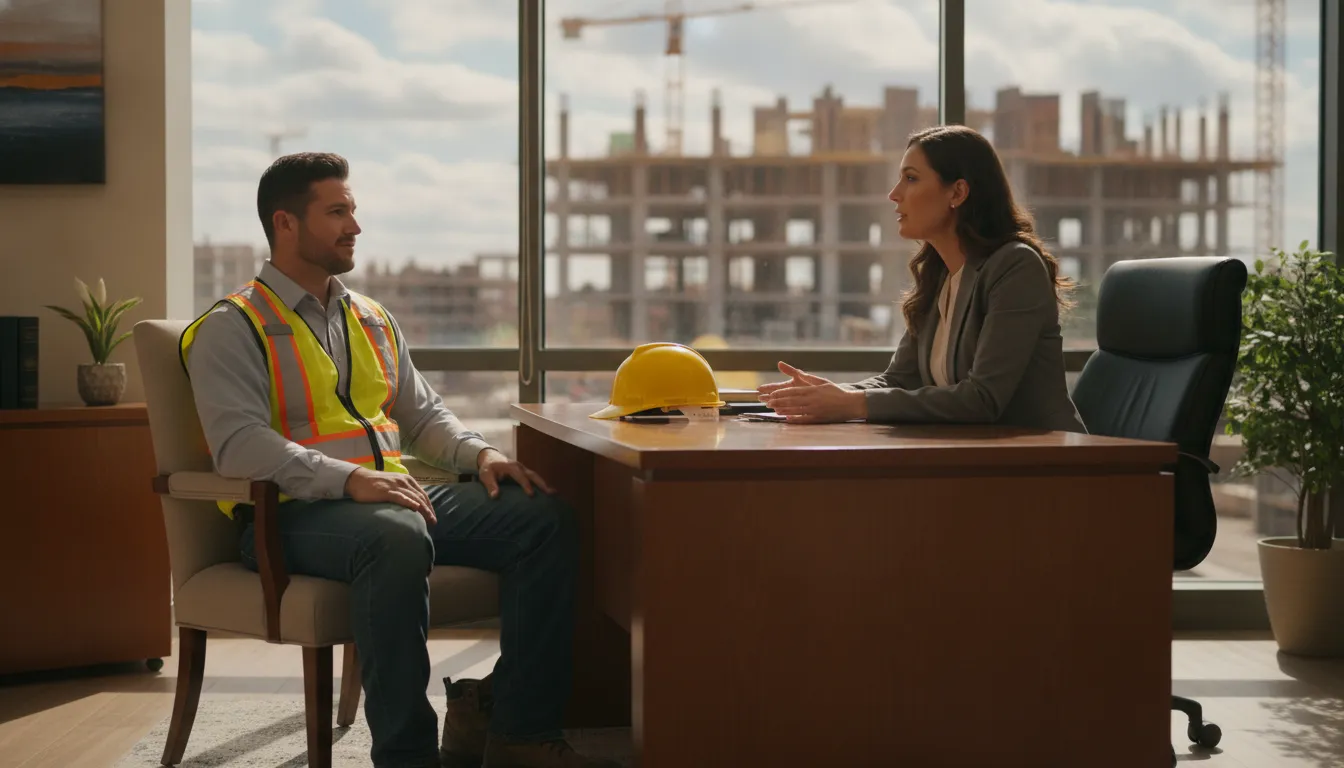
A construction injury can affect your health, paycheck, and ability to return to the job. The first decisions matter: report what happened, obtain appropriate medical care, preserve useful evidence, and learn which claim paths may apply.
Contact Hammack Law Firm about your construction injury
A south carolina construction accident attorney can help you understand how workers compensation, possible third-party claims, medical treatment, wage loss, and claim deadlines may fit your circumstances. The rules depend on the injury, the worksite, and the people or companies involved.
Before considering the next step, it helps to identify what qualifies as a South Carolina construction injury. The distinction between a job-related claim and other potential claims also matters.
What Counts as a South Carolina Construction Injury?
A construction injury is generally a physical injury or illness connected to construction work. It may result from a fall, struck-by accident, equipment failure, unsafe scaffolding, electrical exposure, falling materials, repetitive work, or another job-site hazard. The injury can be sudden, or it can develop over time because of the work. The circumstances matter, including where the incident happened, whose work created the hazard, and whether the condition was connected to your employment.
For an employee hurt while performing job duties, workers compensation is usually the starting point. South Carolina’s workers compensation law is codified in Title 42. The South Carolina Workers’ Compensation Commission identifies medical benefits, lost wages, and permanent disability as categories of benefits available for work injuries. The employer generally has the right to choose the treating doctor for a work-related injury. These rules make prompt reporting and medical documentation important from the beginning.
Workers compensation does not require an injured employee to prove that the employer was negligent in the same way a separate negligence case would. However, it also does not provide recovery for pain and suffering, according to the Commission. Benefit eligibility and amount depend on the facts, including the injury, work capacity, and wage information.
A separate claim may be possible when someone other than the employer or a covered co-employee contributed to the injury. For example, the relevant third party could involve another company working at the site, a property owner, an equipment manufacturer, or a commercial vehicle operator. Whether that path exists requires a fact-specific review of contracts, safety responsibilities, equipment, witnesses, and available evidence. A third-party claim is not automatic simply because the injury occurred at a construction site.
Understanding the distinction between these paths can help you avoid treating a construction injury as only an insurance paperwork problem. If you were hurt on a construction site, Hammack Law Firm can help you organize the reporting and treatment records while you consider your options. Putting the personal back in personal injury means listening to what happened and explaining the questions that may matter. Learn more about third-party workplace injury claims and how they differ from workers compensation.
What Should You Do After a Construction Injury?
A construction injury can leave you dealing with pain, confusion, and pressure to get back to work quickly. Taking organized steps can create a clearer record of what happened while you focus on medical care. The South Carolina Workers’ Compensation Commission provides general reporting guidance, but this section is educational and does not replace advice about your circumstances.
- Get emergency care when necessary. If the injury is serious and requires emergency treatment, seek emergency care first. Tell your employer about the injury at the earliest practical opportunity after receiving urgent care. The Commission specifically advises injured workers to prioritize emergency care in that situation. Read the Commission’s injured-worker FAQs.
- Report the injury immediately. Tell your employer about the workplace injury as soon as possible, even if symptoms seem manageable at first. Construction injuries can become more painful or limiting over time, and an early report helps establish when and where the incident occurred. Ask what incident-reporting process the company uses, and keep a copy or photograph of anything you submit.
- Give notice to someone with authority. Speak directly with a supervisor, manager, or on-site nurse. Telling only a coworker may not be considered notice under the Commission’s guidance. If the first person you contact is unavailable, make a reasonable effort to reach another person in a supervisory role. Note the person’s name, job title, date, time, and the method you used to provide notice.
- Do not lose sight of the 90-day reporting statement. The Commission says that failing to report a work-related injury within 90 days of the accident may disqualify a worker from receiving benefits. That statement is not a reason to wait. Report promptly, use clear language, and document the report even if the employer says someone else will handle the paperwork.
- Preserve evidence without putting yourself or anyone else at risk. If the area is safe and you are physically able, photograph or video the relevant work surface, equipment, safety barriers, lighting, and surrounding conditions. Do not re-enter a hazardous area or interfere with an active investigation. Write down what happened while your memory is fresh, including the task, location, time, equipment involved, and names of witnesses. Save work schedules, messages, notices, medical paperwork, and wage records. Do not alter, discard, or privately repair equipment connected to the incident.
Keep copies of your communications and follow medical instructions. If reporting, treatment, or evidence preservation becomes disputed, a South Carolina construction accident attorney can review the available records. The lawyer can explain possible next steps without assuming that any particular claim or result is available.
What Benefits Can Workers Compensation Provide in South Carolina?
South Carolina workers compensation can provide several forms of support after a job-related construction injury. The South Carolina Workers’ Compensation Commission identifies three main categories: medical benefits, lost wages, and permanent disability benefits. The benefit available in a particular case depends on the injury, medical evidence, work restrictions, and other facts.
Medical care and treatment
Workers compensation may cover reasonable medical care connected to the work injury. In South Carolina, the employer generally has the right to choose the treating doctor. After reporting the injury, the Commission advises asking to see the employer’s recommended medical professional for evaluation and treatment. That does not mean you should ignore serious symptoms or delay emergency care. Seek emergency treatment first when necessary, then notify the employer as soon as possible. See the Commission’s injured-worker guidance for the applicable instructions.
Wage loss and permanent disability
When an injury affects your ability to work, workers compensation may address lost wages. The Commission says benefit amounts depend on factors that include your average weekly wages before the injury, the extent of your injuries, and your ability to continue working. South Carolina’s workers compensation law is found in Title 42. The statute defines average weekly wages using earnings from the employment held at the time of injury during the 52 weeks before the injury, subject to the law’s calculation rules.
Permanent disability is a separate benefit category. Whether it applies, and how the extent of any disability is evaluated, requires attention to medical findings and the specific injury. Avoid relying on an online estimate or an unverified benefit amount. Keep pay records, work schedules, restrictions, and medical documentation so the wage-loss and disability issues can be evaluated using your actual circumstances.
Filing the claim
An employer representative may file paperwork after an accident, but the injured worker still has a filing responsibility. The Commission says an injured worker should complete a Form 50 and file a claim within two years after the accident to protect the right to compensation. It also states that there is no charge for filing a claim. Reporting the injury promptly remains important because the Commission says failing to report it within 90 days may disqualify a worker from benefits.
Workers compensation does not provide recovery for pain and suffering under the South Carolina Workers’ Compensation Act. Other legal options may depend on whether a separate company, property owner, equipment manufacturer, or another responsible party contributed to the injury. For more background, read about South Carolina workers compensation benefits. Hammack Law Firm can help a worker understand which facts and records may matter, without promising a particular result.
How Are Workers Compensation and Third-Party Claims Different?
A construction injury may involve more than one possible legal path, but the paths are not interchangeable. Workers compensation generally begins with the employment relationship and the injury’s connection to work. A separate negligence claim may depend on whether a person or company outside that employment relationship owed a duty, failed to use reasonable care, and caused the injury. Those questions require a fact-specific review. An injured worker should not assume that the presence of a contractor, property owner, equipment supplier, or another company automatically creates liability.
Workers compensation compared with a possible third-party negligence claim
| Issue | Workers compensation | Possible third-party negligence claim |
|---|---|---|
| Main question | Did a work-related injury occur within the employment relationship? | Did a separate person or company owe a duty and cause harm through negligence? |
| What may be available | Benefits can include medical care, lost wages, and permanent disability, depending on the facts. | Recovery, if legally available, depends on proving the required elements and the losses supported by the evidence. |
| Pain and suffering | The South Carolina Workers’ Compensation Commission states that workers compensation does not provide recovery for pain and suffering. | Pain and suffering may be part of damages in some negligence claims, but eligibility and proof depend on the specific facts and applicable law. |
The two paths can also involve different evidence and defenses. Workers compensation records may focus on notice to the employer, medical treatment, work restrictions, and wage information. A negligence claim may require evidence about site control, safety practices, equipment, contracts, warnings, witness accounts, and causation. The same incident can raise questions in both categories, yet each claim must be evaluated on its own legal requirements.
The South Carolina Workers’ Compensation Commission explains the benefits and limits of the workers compensation system, including the pain-and-suffering distinction, in its injured worker FAQs. For a related discussion of how these claim paths can differ, see third-party workplace injury claims. Hammack Law Firm can review the known facts and explain which questions may require additional investigation, without assuming in advance that a particular claim will succeed.
What Evidence Can Support a Construction Injury Claim?
Evidence helps preserve what happened before conditions change and memories become harder to recall. Start with the incident report or other written notice you gave your supervisor, manager, or on-site nurse. Keep a copy if possible, along with emails, text messages, safety reports, and any instructions related to the work being performed.
Document the scene safely
Do not return to a dangerous area or ask someone to take a risk for a photograph. If it can be done safely, take photographs or video of the work surface, lighting, warning signs, barriers, scaffolding, ladders, tools, equipment, and the location where the incident occurred. Include wider views that show the surrounding conditions, not only close-ups. OSHA’s construction standards address scaffolding, fall protection, fall-protection systems, and training, including standards 1926.451, 1926.501, 1926.502, and 1926.503. OSHA also states that employers must determine whether walking and working surfaces can safely support employees. Certain unprotected edges six feet or more above a lower level also require fall protection under 29 C.F.R. 1926.501. Those rules make the condition of the surface, edge, guardrail, or fall-arrest equipment important facts to preserve, not conclusions to assume.
Keep names and records together
Write down the names and contact information of anyone who saw the incident or the conditions beforehand. Note what each person personally observed, without asking anyone to guess or change their account. Keep medical records, discharge instructions, prescriptions, appointment information, and photographs of visible injuries. Also save pay stubs, schedules, tax or wage records, and communications showing missed work or restricted duties. These materials can help connect the injury to treatment and work-related losses.
Preserve notices and deadlines rather than relying on memory. The South Carolina Workers’ Compensation Commission advises prompt reporting and states that failing to report a work injury within 90 days may affect eligibility for benefits. Keep copies of every report and follow-up communication. For a broader checklist, see preserving South Carolina injury evidence. A South Carolina construction accident attorney can review the available records and explain what additional evidence may matter, while the facts remain fresh.
How Do Medical Treatment and Wage Loss Affect a Claim?
Medical records and wage records help show what happened after a construction injury. They can document the symptoms you reported, the care you received, the work restrictions a provider gave you, and the time you could not perform your job. They do not guarantee a particular benefit or claim result, but incomplete records can make it harder to explain the effect of an injury.
Follow the treatment plan and document changes
After notifying your employer, South Carolina workers compensation generally gives the employer the right to choose the treating doctor. The South Carolina Workers’ Compensation Commission advises injured workers to ask to be seen by the employer’s recommended medical professional for evaluation and treatment. That rule does not mean you should ignore an emergency. A serious injury requiring emergency care should be treated first, with notice to the employer as soon as possible. See the Commission’s injured-worker guidance for these instructions.
Attend scheduled appointments when you can, follow medical instructions, and tell the provider about continuing or changing symptoms. Keep copies of discharge papers, work-status notes, prescriptions, referrals, bills, and mileage or appointment information. A simple personal log can also help preserve dates, pain levels, physical limitations, and conversations about modified work. Be accurate rather than dramatic. If a restriction changes, ask the provider to record the change.
Keep clear records of missed work and earnings
The Commission identifies lost wages as one category of work-injury benefits, along with medical benefits and permanent disability benefits. Wage-loss questions often require more than a single pay stub. Save pay statements, time records, schedules, tax or payroll documents, and written communications about missed shifts. Tell the employer how restrictions affected your hours, light-duty assignment, or ability to perform the job. Ask how the absence or modified work is being recorded, and keep your own copy of relevant communications.
South Carolina’s workers compensation law appears in Title 42. The statute defines average weekly wages using earnings from the employment held when the injury occurred during the preceding 52 weeks, subject to statutory calculation rules. The Commission also explains that benefit amounts can depend on average weekly wages, the extent of the injury, and the ability to continue working. Those factors interact differently from case to case, so do not guess an expected payment from a rough estimate or a coworker’s experience.
For a broader overview of evidence, deadlines, and claim stages, review the South Carolina injury claim process. Hammack Law Firm can help a worker organize questions about treatment and wage documentation without promising a particular outcome.
When Should You Speak With a South Carolina Construction Accident Attorney?
You may want legal guidance when the path forward is unclear or the injury affects more than a few days of work. A conversation can help you understand which facts matter, what records to preserve, and whether your situation may involve workers compensation, another company, or a product-related issue. It does not require you to predict the outcome of a claim.
When notice, treatment, or benefits are disputed
Consider speaking with a South Carolina construction accident attorney if your employer says the injury was not reported, questions whether it happened at work, or delays documenting the incident. The South Carolina Workers’ Compensation Commission advises reporting an injury immediately and says notice should go to a supervisor, manager, or on-site nurse. It also states that failing to report within 90 days may disqualify a worker from benefits: South Carolina Workers’ Compensation Commission injured-worker FAQs.
Legal guidance may also be useful if medical care is delayed or denied. The recommended treatment does not address your symptoms, or you are unsure how the employer-selected treating doctor rule applies. South Carolina workers compensation may involve medical benefits, lost wages, and permanent disability, but the specific facts and medical evidence matter.
When the injury affects your ability to work
If you cannot return to your job, can work only with restrictions, or are losing wages, keep records of your schedule, pay, and restrictions. Save communications with your employer, too. The Commission explains that benefit amounts can depend on average weekly wages, the extent of the injury, and your ability to continue working. A worker may also need to file a Form 50 and protect the claim within the applicable deadline. Do not wait until a deadline is close if you are uncertain about what must be filed.
When another party or a serious hazard may be involved
Construction sites often involve general contractors, subcontractors, equipment owners, manufacturers, and other businesses. If someone outside your direct employer may have contributed to the incident, or if a defective tool, vehicle, scaffold, or unsafe surface is involved, ask whether a separate claim could be factually possible. That analysis is distinct from workers compensation and depends on evidence, responsibility, and applicable law.
Serious injuries, hospitalization, permanent limitations, or uncertainty about reporting and filing deadlines are practical reasons to seek guidance promptly. Hammack Law Firm serves injured people across South Carolina and can review the circumstances without promising a particular result.
Talk with Hammack Law Firm about your construction injury
Frequently Asked Questions
Who investigates a construction accident in South Carolina?
The employer or its representative may document the workplace incident and file a workers compensation claim. But that does not replace the injured worker’s responsibility to protect the claim. The South Carolina Workers’ Compensation Commission advises reporting the injury to a supervisor, manager, or on-site nurse immediately. Depending on the facts, safety records, witness accounts, medical records, and information about another company or product may also need to be reviewed.
Can you recover pain and suffering after a construction accident?
Workers compensation does not provide recovery for pain and suffering under the South Carolina Workers’ Compensation Act, according to the South Carolina Workers’ Compensation Commission. A separate claim involving a potentially responsible third party may be different, but whether one exists depends on the specific facts. This includes who caused the condition and what legal relationship that party had to the worksite. Source: South Carolina Workers’ Compensation Commission.
How much does a construction lawyer cost?
There is no single answer for every case. Fee arrangements and case expenses should be explained before representation begins, and you should ask what happens if the matter does not result in a recovery. The Commission does not charge an injured worker to file a workers compensation claim. Hammack Law Firm can discuss the potential claims, available options, and applicable fee terms after learning about the incident.
What should I do if my employer has not reported my injury?
Report the injury yourself to a supervisor, manager, or on-site nurse and keep a written record of when and how you gave notice. The Commission says an employer representative often files a claim. But the injured worker must also file a claim within two years after the accident to protect the right to compensation. The Commission also warns that failing to report a work injury within 90 days may disqualify a worker from benefits. Sources: South Carolina Workers’ Compensation Commission.
Contact us about your construction injury
A construction injury can raise questions about workers compensation, medical treatment, wage loss, and whether another company may be involved. Reviewing what happened and the records you have can help clarify the next step. Hammack Law Firm can discuss your South Carolina construction injury and the concerns affecting you.
Contact Hammack Law Firm through the online contact form.

With over 25 years of legal experience, Paul Hammack provides his clients with a level of trial expertise and strategic insight rarely found in personal injury litigation. Having spent the first eight years of his career working within major insurance defense firms across Georgia and South Carolina, Paul gained an intimate understanding of the “other side’s” playbook. This insurance industry background serves as a unique differentiator for his clients; he knows exactly how insurance carriers evaluate risk and what motivates them to pay top dollar for a claim.
In 2008, Paul founded Hammack Law Firm to move away from the “plaintiff mill” model and focus on building personal relationships with those he represents. As a seasoned litigator, he has tried dozens of first-chair cases to verdict, specializing in high-stakes litigation involving catastrophic injuries and complex truck accidents. His dual-state practice allows him to provide aggressive representation across both South Carolina and Georgia, ensuring victims of negligence receive the maximum financial compensation possible regardless of which side of the state line the accident occurred.
Paul’s commitment to excellence is reflected in his record of significant achievements, including a $10 million tractor-trailer wrongful death settlement and a $3.9 million moped-versus-truck recovery. His credentials and bar admissions in both South Carolina and Georgia underscore his deep roots in the regional legal community. Beyond the courtroom, Paul is a dedicated advocate for his local community, contributing his time and resources to organizations such as the United Way, Red Cross, and Hands On Greenville, all while working to make South Carolina a safer place for everyone.