

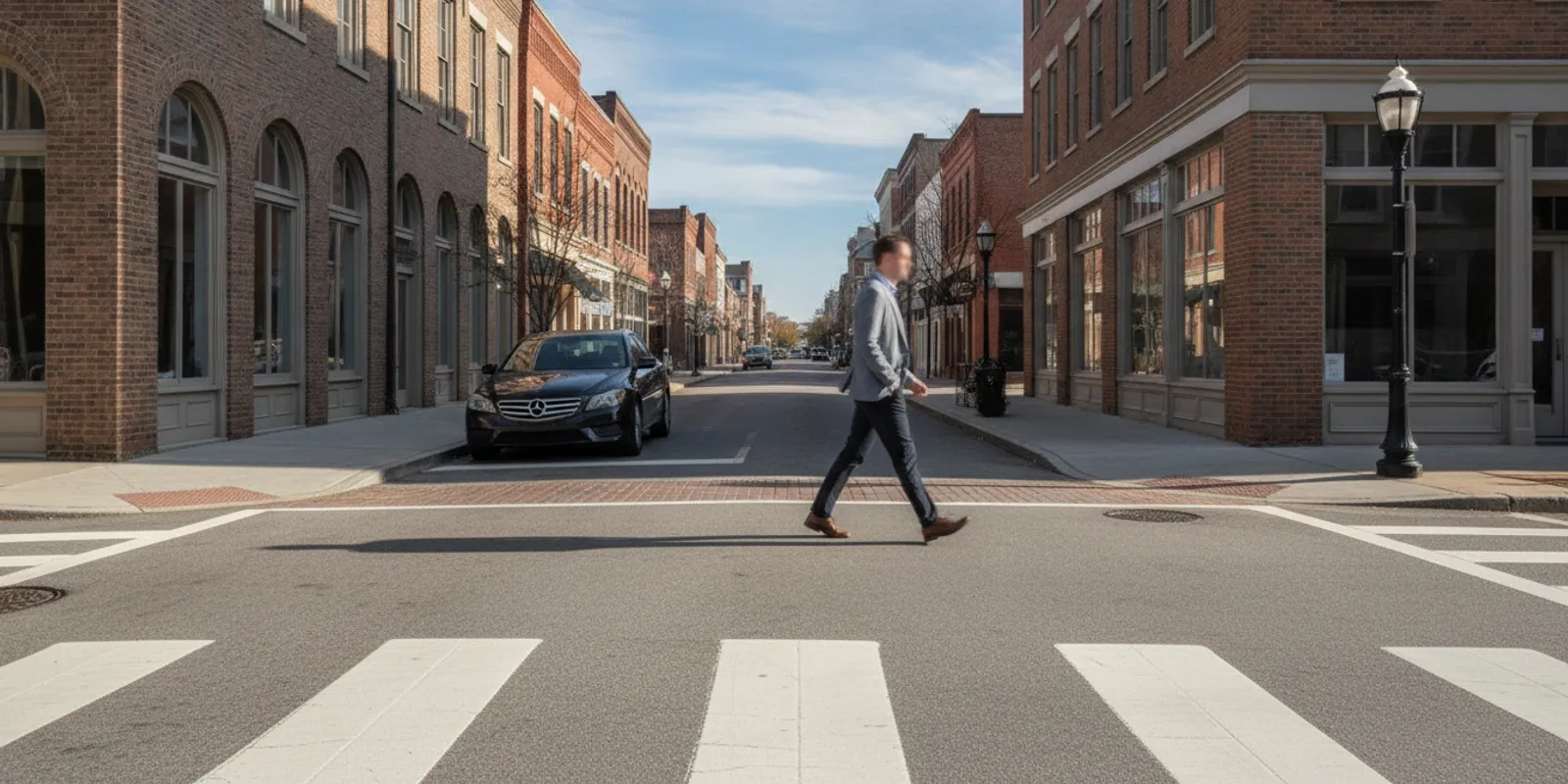
What is a pedestrian accident? It is a collision involving a person traveling on foot and a vehicle or other conveyance, often resulting in injuries that range from bruises to life-changing harm. These crashes can happen in a crosswalk, parking lot, driveway, roadway shoulder, or other place where people and vehicles meet. If you or a family member has been hurt, the details matter: where everyone was, what each person could see, and what happened before impact can shape how a claim is assessed.
Contact Hammack Law Firm to discuss your situation
What counts as a pedestrian accident?
A pedestrian accident generally means a traffic-related collision in which a person on foot is struck or injured by a vehicle. The term can cover more than a person crossing a street. A driver may hit someone walking through a parking area, standing beside a disabled vehicle, using a sidewalk cut-through, or crossing a driveway. A person pushing a bicycle or walking beside a child may also be involved in a pedestrian-type crash.
The label alone does not determine who is legally responsible. Each incident requires a close look at the circumstances, including the location, signals, visibility, speed, and actions of the people involved. Nor does a collision automatically establish that a driver or pedestrian was at fault. Evidence and applicable law matter.
South Carolina’s Department of Public Safety describes driver duties concerning pedestrians, including exercising due care to avoid a collision and yielding in certain situations. See its pedestrian safety guidance. The specific rules can depend on where and how the crossing occurred.
Where do pedestrian crashes happen?
People may think first of a marked crosswalk, but pedestrian collisions occur in many settings. The location can affect what evidence exists and which safety rules may apply.
- Intersections and crosswalks: Turning vehicles, signal timing, visibility, and whether a driver yielded may become important.
- Mid-block crossings: The positions and movements of the pedestrian and driver, sight lines, lighting, and traffic conditions can help explain what happened.
- Parking lots and garages: Backing vehicles, parked cars that block sight lines, pedestrian walkways, and property layout may be relevant.
- Driveways and entrances: Drivers entering or leaving a property may have limited visibility, while people on foot may be moving along a sidewalk or access road.
- Road shoulders: A person walking near traffic may be struck by a vehicle that leaves its lane or passes too close.
- Transit stops and shared spaces: Loading zones, bus stops, and areas with foot and vehicle traffic can create specific visibility and movement issues.
Make a note of the precise location as soon as practical. “Near the store” may be less useful later than identifying the entrance, crosswalk, lane, direction of travel, or nearby signal. Photographs can preserve details that change quickly, such as traffic signs, lighting, weather, and obstructions.
How is fault evaluated after a pedestrian accident?
Investigators and insurers may examine what each person did and what a reasonably careful person could have seen or done under the circumstances. Relevant questions can include whether a driver was turning, backing up, distracted, speeding, or facing an obstructed view. They may also consider whether a pedestrian crossed at a designated crossing, followed a signal, entered the roadway suddenly, or was difficult to see in the conditions.
Those questions are not a shortcut to a conclusion. A pedestrian’s location does not by itself prove fault, and a driver’s account is not the only evidence. A crash may involve more than one contributing factor. South Carolina law can allow fault to be allocated among parties, and the effect of that allocation depends on the facts and the law that applies.
Useful evidence may include:
- Photos or video of the scene, vehicles, damage, signals, signs, lighting, and sight lines.
- Names and contact information for witnesses who saw the collision or events just before it.
- Police reports and any incident number.
- Nearby business, traffic-camera, or doorbell footage, if available and preserved.
- Vehicle event data, when applicable and properly obtained.
- Medical records describing symptoms, diagnosis, and treatment.
- Notes about conversations with insurers and documents received from them.
Evidence can disappear. A store may record over video, vehicles may be repaired, and witnesses may become difficult to reach. If you can safely document the scene, do so. Do not put yourself in traffic or delay medical care to gather photographs.
What should you do after a pedestrian collision?
First, move to safety if you can do so without worsening an injury. Call 911 when anyone may be seriously hurt or when emergency assistance is needed. Ask for medical evaluation, even if you are unsure how badly you are injured. Some symptoms can emerge or worsen after the initial shock has passed.
- Get medical care. Follow the advice of a qualified medical professional, explain all symptoms, and keep copies of discharge instructions and follow-up information.
- Report the collision. Request law enforcement assistance where appropriate, and keep any report or incident details you receive.
- Record what you can safely observe. Photograph the surroundings, vehicle position, visible injuries, and conditions. Ask witnesses for their names and contact details.
- Keep relevant records. Save bills, receipts, work absence information, prescriptions, and messages related to the event and your care.
- Be careful with statements. You can provide basic information needed for emergency response and reporting. Before giving a recorded statement or accepting a settlement, consider getting advice about what the request means.
- Ask about preserving evidence. Video, vehicle data, and other records may not be kept indefinitely.
A simple sequence can make a stressful day more manageable. For example, once emergency responders have taken over and you are safe, ask a trusted person to photograph the location and note the time. Later, make one folder for the report, treatment papers, photographs, and insurer letters. A relative can help maintain the folder if pain, medication, or mobility makes paperwork difficult. Do not ask anyone to guess at facts or alter an image; a clear record is more useful than a polished story.
If you were in a vehicle rather than on foot, Hammack Law Firm also has information about car accident claims in Greenville. For location-specific pedestrian resources, see the firm’s Seneca pedestrian accident page or Anderson injury resources.
How do injuries and medical records fit into a claim?
A pedestrian has little physical protection from a vehicle, so injuries may be serious. A person might sustain fractures, head trauma, spinal injuries, internal injuries, or soft-tissue damage. The medical picture may change over time. Initial emergency treatment, imaging, follow-up appointments, rehabilitation, and specialist care can all help document how the injury developed and affected daily life.
Keep a simple record of symptoms and limitations. Note pain, mobility challenges, sleep disruption, missed work, help needed at home, and changes in routine. A brief dated note is often easier to maintain than trying to reconstruct several weeks at once. Preserve bills and receipts, but do not assume every cost will necessarily be recoverable; legal and factual issues affect what a claim may include.
Do not skip or change prescribed care based only on an insurer’s position. Discuss treatment questions with your health care provider. If you have a gap in care, be prepared to explain the reason accurately, such as scheduling difficulties or a provider’s instructions.
Build a useful record without turning recovery into a second job
Documentation can be brief and consistent. On a calendar or in a notebook, record the date of each appointment, the provider, the instructions you received, and the next planned step. If a symptom changes between appointments, add a short note describing when it began and what activity it affected. Avoid diagnosing yourself; describe what you experienced in ordinary language, such as “needed help getting up stairs” or “could not carry groceries.”
Keep original paperwork when possible and save digital copies in a secure place. A receipt for a prescription or transportation expense can be filed by date. If you miss work, keep whatever records your employer provides about schedule changes or lost time. The goal is not to create a perfect ledger. It is to reduce reliance on memory when weeks or months have passed.
What may an insurance company ask?
An insurer may seek information about the collision, your injuries, treatment, prior medical history, work, or other matters. Some requests may be routine, while others may have legal significance. Read forms before signing them, ask what a requested authorization covers, and keep copies of everything you send or receive.
You do not need to guess about answers or fill gaps with assumptions. If you do not know a detail, say so. Avoid speculating about speed, distance, or fault. Be accurate, and distinguish what you personally observed from what someone else told you. A short, factual account is usually clearer than an effort to explain every uncertainty immediately.
For example, “I was walking west toward the store entrance, and the vehicle came from the driveway” describes observations. “The driver must have been looking at a phone” is a conclusion unless you actually saw that. If you later remember another detail, keep a note of when you remembered it rather than trying to make an earlier statement sound more certain. Save letters and emails, write down dates of calls, and note the name of the person you spoke with.
Before agreeing to a settlement, consider whether you understand the release and whether the amount addresses the injury and its known effects. A signed release may limit your ability to pursue additional compensation later. The right decision depends on the specific facts, available records, and applicable law.
What details can change the next steps?
Not every pedestrian collision follows the same path. The following comparisons show why identifying the setting and evidence can be useful; they are not legal conclusions about any particular person’s rights.
| Situation | Details to document | Questions that may arise |
|---|---|---|
| Marked crosswalk | Signal phase, crosswalk markings, turning movement, sight lines | Who had the signal? Did a turning driver see or yield to the pedestrian? |
| Parking lot | Vehicle direction, parked-car obstructions, lighting, walkways, signs | Was the driver backing or turning? Were there visibility limits? |
| Roadway outside a crosswalk | Distance to a crossing, traffic speed, lighting, pedestrian route | What could each person see, and when could they react? |
| Driveway or property entrance | Sidewalk position, entrance design, vegetation, vehicle movement | Was the vehicle entering or exiting? Were sight lines blocked? |
| Hit-and-run or unclear vehicle identity | Witness accounts, vehicle description, camera locations, timing | Can other records help identify the vehicle or driver? |
Consider two hypothetical examples. At an intersection, a pedestrian may recall a walk signal, while a nearby camera could show the timing and a vehicle’s turn. In a parking area, the central question may instead involve a reversing vehicle and an obstruction created by parked cars. Both are pedestrian collisions, but the useful evidence differs. This is why a broad label does not answer responsibility by itself.
For every situation, medical needs come first. Then preserve what remains available, including photos, witness information, and records. The table is a starting point, not a substitute for a fact-specific review.
How can you organize the facts before a conversation?
A short, neutral timeline can help you explain an event without trying to solve every legal question yourself. Start with the date, approximate time, and exact location. Add what you remember about your route, the vehicle’s direction, weather and light, the point of impact, and what happened immediately afterward. Mark uncertain details as uncertain. If someone else supplied a detail, identify the source rather than presenting it as your own observation.
Next, group documents into four practical categories:
- Scene: photographs, witness details, report number, and any notes about signals, signs, or visibility.
- Care: visit summaries, instructions, medication lists, referrals, and appointment dates.
- Effects: work absences, household help, mobility changes, and expenses you have records for.
- Communications: insurer letters, forms, emails, and a dated log of calls.
Keep the categories simple. If you do not have a report yet, leave that spot empty rather than delaying everything else. If a relative is helping, agree on one place to save new documents so that copies do not scatter across text messages and email. Do not post private medical details or scene speculation publicly; keep records for appropriate conversations with providers, insurers, or counsel.
How do location and roadway conditions matter?
Conditions can affect what a driver and pedestrian could see, but they rarely tell the whole story by themselves. Darkness, glare, rain, parked vehicles, landscaping, construction, and street lighting may all be relevant. The useful question is not simply whether conditions were poor; it is how they affected visibility and movement at the time.
For instance, a photograph taken days later may show a tree or sign but not establish exactly what the view looked like at the moment of impact. Note whether the obstruction was temporary, such as a delivery truck, or permanent, such as a wall or hedge. Record weather and lighting promptly. If road work or a temporary closure changed the route, note where barriers and signs were placed. Do not trespass or enter traffic to investigate.
In South Carolina, the Department of Public Safety’s pedestrian laws and safety page summarizes duties and safety information for drivers and people walking. Use it as general information, not a final answer about a particular collision. The specific facts and current law still need to be considered together.
How long do you have to act?
Legal deadlines can limit the time to bring a claim, and the applicable deadline may depend on who is involved and the circumstances. Do not assume that an insurance conversation pauses a legal deadline. Promptly identifying the date of the crash and getting advice about any applicable time limits can help you avoid relying on a guess.
Evidence has its own practical timeline. Video may be overwritten, vehicles may be repaired, and memories may fade well before a legal deadline arrives. If an injury is involved, consider preserving records and asking about steps to protect relevant evidence early.
When may a legal review help?
A conversation with a lawyer may be useful when injuries required medical care, fault is disputed, the insurer requests a recorded statement or broad medical authorization, a settlement offer arrives, or evidence needs to be preserved. A legal review can help clarify the issues and the next steps; it does not guarantee a particular outcome.
Hammack Law Firm represents people injured in motor vehicle and pedestrian incidents. Paul Hammack’s background includes years representing insurance companies before representing injured people. That perspective can inform a discussion about how an insurer may evaluate a claim, while the facts of each collision remain unique. Learn more about the firm’s personal injury practice and reported case results.
If your crash involved a commercial vehicle, the circumstances may raise additional investigation questions. Hammack Law Firm provides information about truck accident claims. Keep the focus on your own injuries and the evidence in your situation rather than assuming that another case’s facts or result will apply.
Reach out to discuss your next steps
Frequently asked questions
Is a crash in a parking lot a pedestrian accident?
It can be. If a person on foot is struck by a vehicle in a parking area, the event may be treated as a pedestrian collision. The layout, signs, vehicle movement, visibility, and available witnesses can matter when examining what happened.
Can a pedestrian be partly responsible?
It is possible for fault to be disputed or shared. The answer depends on the evidence and South Carolina law, including the conduct of everyone involved. A conclusion should not be drawn from the fact that a person was outside a crosswalk alone.
What if I felt fine immediately after the collision?
Symptoms can appear or intensify later. Seek medical advice if you have concerns, and follow a qualified provider’s recommendations. Prompt and accurate documentation can help explain the timing and course of your symptoms.
Should I accept the first insurance offer?
Do not feel pressured to accept before you understand the offer, release, and known effects of your injury. A settlement can affect future claims. Consider reviewing the terms and getting legal advice before signing.
What if the driver left the scene?
Report the collision and provide any vehicle or driver details you remember. Witnesses, nearby cameras, and other records may help clarify what happened. Seek medical care and preserve the information you have as soon as practical.
Contact Hammack Law Firm to discuss a consultation
Every pedestrian collision is different, and the next step depends on the injury, evidence, and applicable law. If you would like to discuss a South Carolina pedestrian injury, Hammack Law Firm can hear your concerns and talk through possible next steps.


