

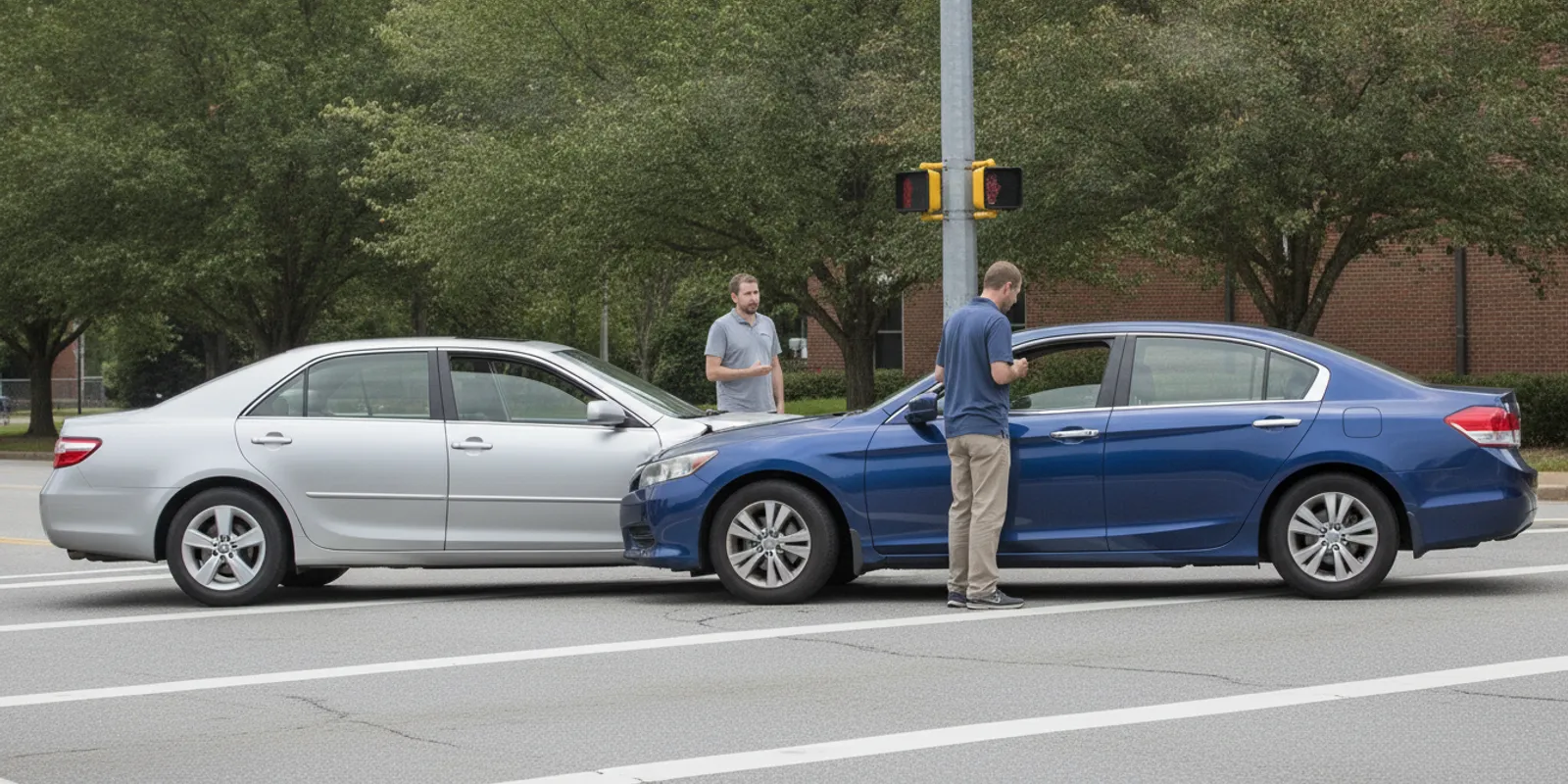
A side-impact crash can leave a driver with urgent questions: who had the right of way, what evidence can answer that, and whether more than one person may share responsibility? Understanding T-bone accident liability in South Carolina starts with the events leading to impact, not just the final position of the vehicles. Signal phases, turning movements, sight lines, damage, and independent accounts can all matter. A careful review looks at each piece in context and does not assume that the driver whose car was struck automatically wins a claim.
Contact the firm to discuss your crash
What does a T-bone collision show—and what does it not show?
A T-bone collision, also called a side-impact or broadside crash, occurs when the front of one vehicle strikes the side of another. The shape of the damage can help describe how the vehicles met, but it does not, by itself, establish who was legally responsible. A car can be struck on its side even when the other driver entered lawfully, for example, if the struck driver made a late turn or entered against a signal. The reverse may also be true: a driver who entered an intersection without yielding may cause a side impact even if the other vehicle was moving quickly.
Responsibility depends on evidence about the drivers’ actions and the applicable traffic rules. Investigators may ask where each vehicle came from, which direction it was traveling, whether it was turning, what the traffic controls displayed, and whether a hazard affected what either driver could see. The crash location matters, too. A signalized intersection, an unmarked neighborhood crossing, and a private driveway present different questions.
It is useful to separate three questions:
- What happened? Reconstruct the sequence, movement, and timing from available evidence.
- Which actions may have contributed? Consider conduct by each driver and any other relevant circumstance.
- What losses followed? Connect documented injuries and other damages to the collision.
These questions overlap, but one does not answer all the others. A photograph can show a damaged door; it cannot establish the traffic light color at impact. A witness may recall a signal but not see the vehicles’ approach. Each item has limits, so the review should compare sources rather than rely on one conclusion.
How does right of way affect a South Carolina intersection crash?
Right of way is often central to a T-bone crash review, but it is not a shortcut to deciding liability. The relevant details include the kind of intersection, the signs or signals in place, each vehicle’s direction, and whether someone was turning, entering from a side road, or proceeding through the intersection. A driver’s account should be compared with physical evidence, witness recollections, and any available video.
What if the crash happened at a traffic light?
At a signalized intersection, a key question is what indication each driver faced as they entered. A red-light allegation needs support. Possible sources include a camera recording, a witness who had a clear view of the signal, a nearby business recording, or a detailed account that fits the signal cycle and the vehicles’ movements. The fact that a driver had a green light does not answer every question, either. A turning driver may need to yield, and a driver proceeding on green still must react to an apparent hazard when reasonably possible.
Signal timing may matter if a recording shows the moment a light changed, but timing should not be guessed from memory alone. Note the intersection, direction of travel, lane, turn, and approximate time. If a witness saw the light, ask for their own words and contact details rather than suggesting what they should say. Do not edit or annotate the original recording or message.
What if there were stop signs or no signal?
At an intersection controlled by signs or no signal, the review may focus on who arrived first, whether a driver came to a full halt, whether one vehicle was already in the intersection, and what each driver could see. A person may have a duty to yield under the circumstances, but road layout and visibility can affect what a driver observed and when. Faded markings, parked vehicles, foliage, darkness, or a blocked view may be relevant. Record those conditions as they existed; do not assume they establish fault on their own.
At a driveway or parking-lot exit, a vehicle entering a public road may face different right-of-way questions than one traveling along it. A collision in a shopping center can also involve private cameras or property records. Preserve the exact location and identify nearby businesses or properties promptly, because some systems overwrite recordings on short cycles.
Which evidence can help explain how the impact happened?
Useful evidence may come from several sources. Its value depends on what it actually records, when it was collected, and whether it can be connected to the collision. A coherent timeline is often more helpful than a pile of unlabelled files.
| Evidence source | What it may help clarify | Limits or next step |
|---|---|---|
| Intersection, traffic, or business video | Vehicle approach, signal indications, turns, and approximate timing | Coverage may miss the signal or impact; request preservation promptly and retain the original file. |
| Witness accounts | What a person saw or heard before and during the crash | Viewpoint and memory vary; record contact details and the witness’s words without coaching. |
| Vehicle photographs and inspection | Impact location, damage patterns, debris, and possible contact points | Damage alone rarely determines right of way; photograph all sides and preserve repair records. |
| Scene photographs and measurements | Lane layout, signs, sight lines, debris, and final positions | Conditions change; note the date and direction of each image and avoid entering traffic. |
| Police documentation | Driver and witness information, scene observations, and reported accounts | It may not resolve disputed facts; obtain the report and check it for errors or omissions. |
| Medical and treatment records | When symptoms were reported and how injuries were evaluated | Records address health care, not necessarily crash fault; keep follow-up information complete. |
Why do vehicle damage and final positions matter?
Damage location can help identify which parts of the vehicles contacted one another. Photos of both vehicles, including close-ups and wider views, can document the damage before repairs. If a car must be repaired or moved, keep estimates, invoices, and any inspection records. Do not discard damaged parts or authorize avoidable destruction of potentially relevant evidence before understanding whether it should be preserved.
Final resting positions, debris, skid marks, and roadway marks may help explain movement, but the scene changes quickly. If it is safe, photographs taken from several angles can capture signs, signals, lane markings, nearby entrances, and sight obstructions. Include landmarks so the images can later be oriented. Never stand in an active lane or delay emergency care to collect evidence.
Damage severity is not a direct measurement of speed, attention, or fault. Vehicle design, point of impact, angle, and other conditions affect how damage appears. Avoid drawing a firm conclusion from a single picture or a repair estimate.
How can witnesses and cameras fill gaps?
A witness may have seen the signal or the vehicles’ approach, while a camera may show only a few seconds of the event. Ask witnesses for their name and a reliable way to reach them. Write down where each person stood or sat and what they say they saw, without prompting a conclusion. Someone who saw only the aftermath may still have useful information, but their account should not be treated as a view of the impact itself.
Look for cameras on nearby homes, stores, parking lots, buses, or commercial vehicles. Record the location and request that relevant footage be retained as soon as practical. A polite request does not ensure the owner will provide a copy, and footage may be overwritten. Keep the original file and note who supplied it and when. Do not post it publicly or add captions that imply a conclusion before the sequence is understood.
For general roadway-safety information, the National Highway Traffic Safety Administration provides public resources. Those materials address broader safety topics; they do not determine responsibility in an individual South Carolina crash.
Can more than one person share fault?
It is possible for more than one person’s conduct to be examined. A driver may claim the other person failed to yield, while the other may argue that the first driver entered too quickly, turned across traffic, or failed to respond to a visible hazard. A careful analysis considers the evidence for each account and how the alleged conduct relates to the collision and claimed injuries.
South Carolina uses a comparative-fault framework. In general terms, a person’s own share of responsibility can affect recovery, and the amount attributed to each party may be disputed. The precise effect depends on the facts and the law applicable to the particular claim. Avoid relying on informal percentage estimates made before the evidence is gathered. A statement such as “I’m sorry” or an early guess about speed is not a substitute for a complete investigation, but statements can be recorded and later considered in context.
Fault arguments may involve more than the two drivers. For example, a vehicle owner, employer, or other party could be relevant in some circumstances, depending on the evidence and legal relationship. Do not assume that another party is responsible simply because their name appears on paperwork. Identifying potentially relevant people and businesses is a reason to preserve records and obtain legal advice, not a guarantee of a claim against them.
What should you do after a T-bone crash?
Start with safety and health. Call emergency services when needed, move away from immediate danger if possible, and follow medical guidance. Some injuries may not be obvious in the first moments after impact. Tell a health professional about new or worsening symptoms and follow the recommended evaluation and care. Keep copies of visit summaries, referrals, prescriptions, and work restrictions.
- Make a factual record. As soon as you are able, write down the date, time, location, direction of travel, lane, signal or sign, weather, and your recollection of events. Separate what you personally remember from what someone later told you.
- Photograph what can safely be documented. Take wide and close views of the vehicles, scene, traffic controls, and visible injuries. Keep the original files and note when they were taken.
- Collect witness and vehicle information. Exchange required information and note witnesses’ contact details. Do not argue about fault at the scene.
- Request preservation of recordings. Identify nearby cameras and act promptly. Keep a copy of any messages or confirmation about a preservation request.
- Keep claim and expense records. Save repair estimates, towing or rental documents, medical bills, pay information, and insurer communications. Organize them by date.
- Review official paperwork. Obtain available crash documentation and point out factual mistakes through the appropriate process. A report is one source, not necessarily a final decision about civil liability.
When speaking with an insurance representative, answer honestly and keep your account factual. You can ask what information is being requested and take time to review documents before signing or giving a recorded statement. Do not alter evidence or guess when you do not know an answer. If you have questions about how a statement or proposed resolution may affect you, consider getting legal advice before deciding.
A related overview of collision issues is available on the firm’s Greenville car accident page. Its information cannot determine what happened in a specific T-bone crash, but it can help identify topics to discuss.
How can you make a useful crash timeline?
Use a simple timeline to keep separate facts that are easily blurred together after a stressful event. Note when you approached the intersection, what you recall seeing, when impact occurred, what happened immediately afterward, and when you spoke with witnesses, insurers, or health professionals. Mark any uncertain time as approximate. If you later obtain a video or report that differs from your memory, preserve both and note the difference rather than silently rewriting your account.
A hand-drawn diagram can also help record direction and position. Label the streets, lanes, traffic controls, points of entry, direction of travel, and where you believe the vehicles made contact. Identify which details come from your own recollection and which came from a report or another person. A diagram is a memory aid, not a scaled reconstruction, so state that plainly and do not add details you cannot recall.
Keep original digital files where possible. A screenshot may be useful for quick reference, but it can omit the recording’s source or metadata. Save messages about a camera request, the name of the person who responded, and any date by which footage may be available. Organized records make it easier to identify what remains uncertain without presenting guesses as established facts.
How do injury records fit into a liability review?
Liability and the extent of injury are related but distinct parts of a claim. Evidence about the intersection may help explain who caused a collision; treatment records may document the injury, symptoms, and care that followed. Keep a simple dated log of appointments, symptoms, limitations, and time missed from work. Be accurate and avoid exaggerating or minimizing what you experience.
Tell clinicians about the collision and the symptoms you are experiencing, including when they began. Follow instructions and ask questions if a treatment plan is unclear. Keep records of changes over time rather than trying to write a perfect account after many weeks. If a symptom improves or returns, document that honestly. Consistent records help distinguish what was known at different points in the recovery process.
Keep property damage information separate from injury records. Vehicle repair costs do not establish medical harm, and an injury does not by itself identify which driver had the right of way. A complete file makes it easier to see what is known, what remains uncertain, and which documents may be needed.
When may a legal review help?
A legal review may be useful when the drivers give conflicting accounts, an intersection camera may hold important footage, the crash caused significant injury, or an insurer disputes responsibility. It can also help organize questions about shared fault, possible additional parties, and records that should be preserved. The firm’s frequently asked questions and case results information provide additional background, but no general page can predict the outcome of an individual matter.
For a review, gather what you have without delaying medical care: the crash report or exchange information, photographs, witness contacts, insurer letters, repair paperwork, and a short timeline. If something is missing, note that rather than trying to recreate or alter it. Hammack Law Firm handles motor vehicle and truck accident matters; details such as location, injury, treatment, and the time since the crash can affect whether a matter fits its practice.
Claims have deadlines, and the time limit can depend on the facts and applicable law. Do not rely on a general blog post to calculate a deadline or assume that negotiations pause it. If you are unsure, ask a lawyer promptly about the time limits that may apply.
Ask the firm about a case review
Frequently asked questions
Does a T-bone crash automatically mean the other driver was at fault?
No. Side damage identifies the type and location of impact, but does not by itself establish who had the right of way or whether more than one person contributed. Signal evidence, vehicle movements, witness accounts, and other facts need to be considered together.
What if both drivers say they had a green light?
Try to identify evidence that can clarify the sequence, such as a video, a witness with a clear view, or details about each vehicle’s direction and movement. Do not assume a recollection is conclusive. Preserve recordings promptly and document the intersection and approximate time.
Can vehicle damage prove who entered the intersection first?
Damage can help show contact points and may contribute to an analysis, but it rarely answers that question alone. Scene evidence, video, witness accounts, and a qualified inspection may add context. Keep photographs and repair records before and during repairs.
What if I think I may have made a mistake?
Be truthful, do not guess, and preserve relevant records. South Carolina’s comparative-fault framework may make each person’s conduct relevant, but an early impression does not settle how responsibility will be evaluated. A lawyer can review the facts and explain issues that may apply.
How quickly should I ask a business to save video?
As soon as practical. Some recording systems overwrite footage, and the owner may need a precise time and location to find it. Send a clear preservation request, keep a copy, and do not assume that asking guarantees access to the recording.
Contact Hammack Law Firm to discuss next steps
Bring the information you have, and the firm can discuss whether a review may be appropriate for your circumstances.
Every intersection collision has its own facts, and no single photograph or account decides liability by itself. Preserving reliable evidence and documenting treatment can help make the questions clearer as you consider what to do next.

With over 25 years of legal experience, Paul Hammack provides his clients with a level of trial expertise and strategic insight rarely found in personal injury litigation. Having spent the first eight years of his career working within major insurance defense firms across Georgia and South Carolina, Paul gained an intimate understanding of the “other side’s” playbook. This insurance industry background serves as a unique differentiator for his clients; he knows exactly how insurance carriers evaluate risk and what motivates them to pay top dollar for a claim.
In 2008, Paul founded Hammack Law Firm to move away from the “plaintiff mill” model and focus on building personal relationships with those he represents. As a seasoned litigator, he has tried dozens of first-chair cases to verdict, specializing in high-stakes litigation involving catastrophic injuries and complex truck accidents. His dual-state practice allows him to provide aggressive representation across both South Carolina and Georgia, ensuring victims of negligence receive the maximum financial compensation possible regardless of which side of the state line the accident occurred.
Paul’s commitment to excellence is reflected in his record of significant achievements, including a $10 million tractor-trailer wrongful death settlement and a $3.9 million moped-versus-truck recovery. His credentials and bar admissions in both South Carolina and Georgia underscore his deep roots in the regional legal community. Beyond the courtroom, Paul is a dedicated advocate for his local community, contributing his time and resources to organizations such as the United Way, Red Cross, and Hands On Greenville, all while working to make South Carolina a safer place for everyone.


